
Gutter Installation
Protect Your Foundation: Gutters, Grading and Drainage
Gutters protect foundation walls only if the water they collect is carried several feet clear of the house and the soil slopes away from the wall. The gutter is the first of four links, with the downspout, the discharge and the grade. If any one fails, roof water ends up beside the foundation anyway.
- ★ 5.0 on Google · 29 reviews
- Serving since 2024
- Based in Hampstead, NH
Published and updated November 2, 2026 · By the Lanes Gutters crew, Hampstead, NH
On this page
- How gutters protect foundation walls
- Is your gutter sized to catch it?
- Where should the downspout empty?
- What grading should do
- What a crew checks when a corner stays wet
- Winter and spring: when the ground is frozen
- Merrimack lots and runoff
- A foundation protection plan you can start this week
- Common questions
One inch of rain on 1,000 square feet of roof is about 620 gallons of water, and all of it has to go somewhere. Gutters decide where that is.
How gutters protect foundation walls
Soil beside a foundation holds water against the wall. Wet soil presses on the wall and seeps through cracks and the joint where the wall meets the floor. In winter that water freezes and expands. Keeping roof water out of that soil lowers the load on the foundation.
The job splits into four steps. Skip any one and the others lose most of their value.
- Collect. Gutters sized and pitched to catch all of the roof's runoff.
- Carry. Downspouts placed where they can drain the whole run.
- Discharge. Extensions or buried pipe that deliver water well away from the wall.
- Grade. Soil that slopes away from the house, so water that falls near it keeps moving.
A worked example: how much water, per year
Hampstead gets about 45.9 inches of precipitation a year (BestPlaces). Rain falls on the footprint of the roof, and one inch on 1,000 square feet is about 620 gallons. So for a house with a 1,500 square foot roof footprint, that is 1.5 x 45.9 x 620, or roughly 42,700 gallons a year (about 28,500 gallons for each 1,000 square feet), and a portion of it comes as snow that melts in a few days.
That is the volume the four-link chain has to move, mostly in a few dozen storms. On a house with four downspouts, one blocked outlet puts a quarter of the roof's runoff against one wall. These are rough, illustrative numbers, not a drainage design, but they show why one short extension that is ignored for years can matter.
Is your gutter sized to catch it?
A 5-inch K-style gutter is rated for about 5,520 square feet of roof and a 6-inch for about 7,960, at 1 inch of rain per hour (standard sizing chart). Heavy rain or a steep roof lowers those numbers. Overflowing water falls straight beside the wall, so an undersized gutter skips step one entirely.
Downspouts matter just as much. A practical maximum run is about 50 feet per downspout (SMACNA), and a long run on a big roof needs more than one outlet.
Where should the downspout empty?
Pick the option that fits the lot. Compare them side by side:
| Discharge | Typical reach | Best for | Watch for |
|---|---|---|---|
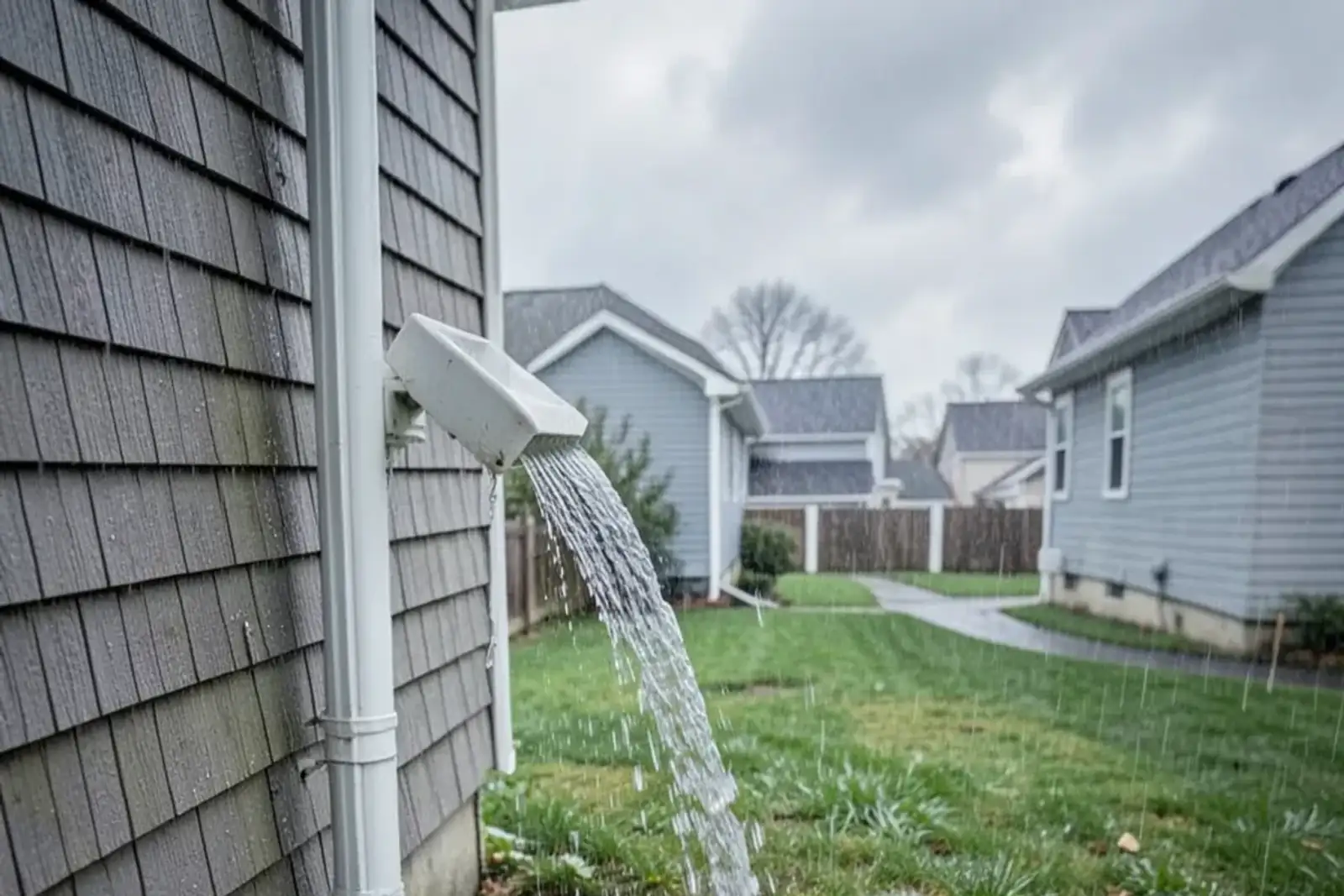
| Splash block | 2 to 3 feet | Level ground with good grade | Water running back to the wall |
| Rigid or flexible extension | 4 to 10 feet | Most homes | Kinks, crushed pipe and mower damage |
| Hinged extension | Lifts for mowing | Yards that get mowed | Staying folded up after the lift |
| Buried drain line | Runs to a daylight outlet | Flat lots or finished landscaping | Needs slope, Dig Safe and checks |
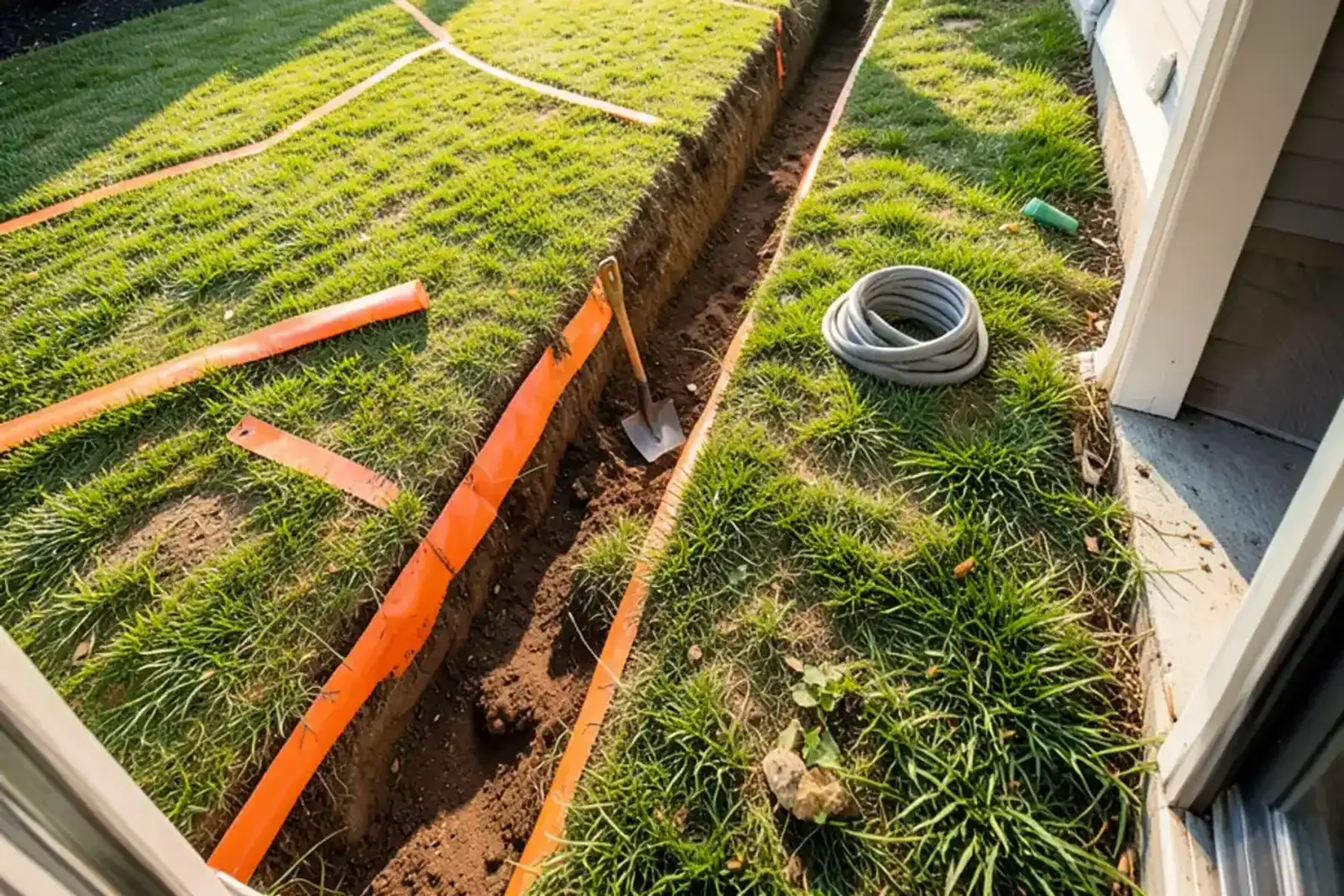
For buried lines, the pipe needs slope all the way to an outlet and a clean connection at the downspout. Published guidance on buried pipe varies, from roughly an inch of fall per 8 feet of run to more than half an inch per foot, so ask any installer which figure they use and where the pipe daylights. Buried drain lines are a job to price case by case. Call and ask what we could assess and quote for your lot, and ask any installer how they set the slope and where the pipe comes out.
What grading should do
The soil next to a foundation should fall away from the wall. A common rule is about 6 inches of drop over the first 10 feet, and building codes commonly use that figure. Check it with a level and a straight board, or a string line, then look at the low spots.
Published guidance varies, and honest sources disagree. Some homeowner guides ask for 2 to 3 inches of drop in the first 10 feet and others ask for 5% or more, which is 6 inches in 10 feet. A steeper grade moves water faster but is harder to build around a patio or door. If you cannot reach the steeper figure on a tight lot, a gentle grade with a longer extension and a swale is better than nothing.
Common grade problems:
- Soil that settled against the wall after the house was built
- Mulch or landscape edging that traps water in a bed
- A walkway or patio that tilts toward the house
- Flower beds raised higher than the foundation line
Fill settled soil with compacted fill rather than loose topsoil, which soaks up water and settles again. Keep mulch below the siding line, and rebuild a shallow swale if a low spot collects water.
In winter, watch where the discharge lands. Water that spills across a walkway or driveway freezes into a slick patch, so aim the outlet at open ground or a grassed slope instead.

What a crew checks when a corner stays wet
This is trade knowledge and not a story about a job.
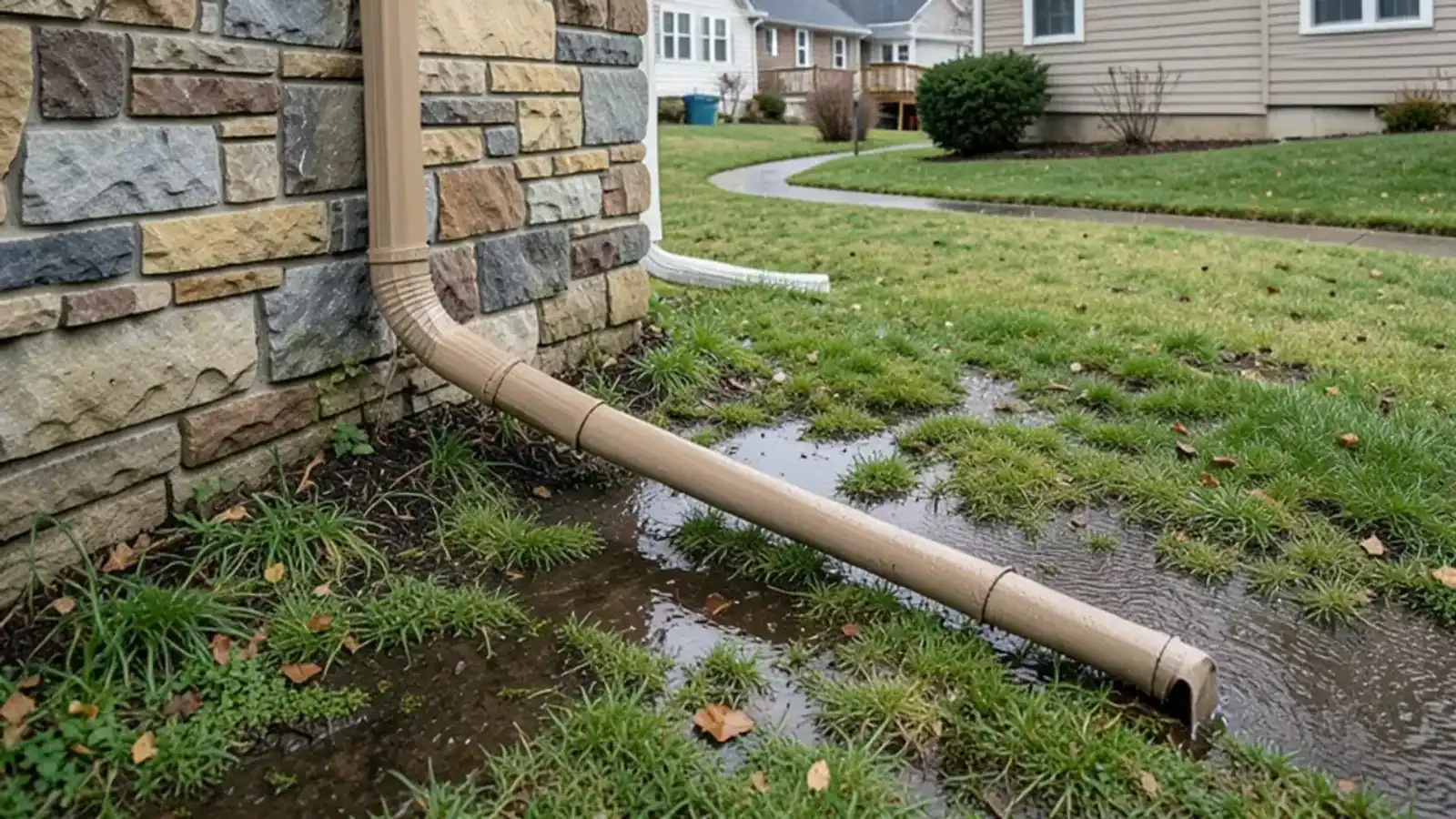
When a basement corner stays wet, a crew looks at the roof above it first. Valleys funnel runoff into one point, and that point often has the downspout. Then they check the downspout bottom. A crushed elbow, a disconnected extension or a splash block tilted toward the house sends the full flow against the wall.
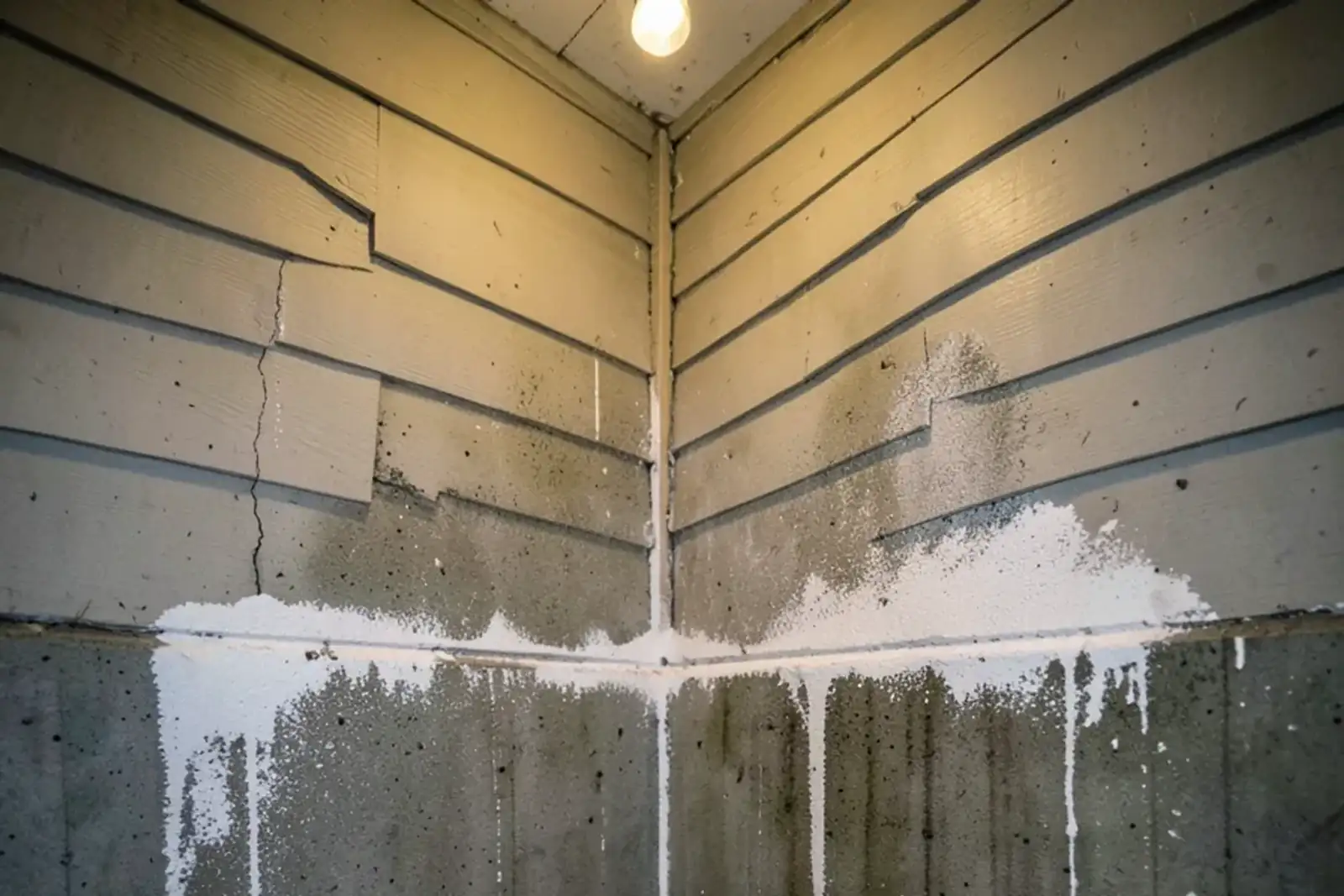
Next comes the grade, and the sign to look for is a shallow trench or bare patch at the drip line. White powder on a basement wall, called efflorescence, shows that water is moving through the masonry, though it does not say where it came from. A wet spot that appears only after rain points to roof water. A wet spot that stays after a dry week points to groundwater, which gutters cannot fix.
A simple test: roof water or groundwater?
Before spending money, spend a week watching.
- After a dry spell, note whether the basement spot is damp. If it is, groundwater is more likely.
- After the next rain, check the spot again, and look outside at the downspout above it.
- Run a hose into the gutter above the wet corner for 15 minutes on a dry day, with the outlet watched. If the basement dampens within a day, roof water is the cause.
- Keep notes on the date, rainfall and the spot. A pattern is more useful than one wet day.
A corner that only gets wet after the hose test is a gutter or discharge problem, and you can fix it from outside. A corner that stays wet after a week of dry weather is a different job, and a gutter contractor cannot fix it. Ask a foundation or waterproofing specialist.
Winter and spring: when the ground is frozen
New Hampshire's frozen ground changes how water leaves your house. Frozen soil does not soak water up, so meltwater and rain run on top of it, and low grade or backward grade shows up fast in March. About 62 snow-cover days a year in Hampstead (Dwellics) means a long season of thaw-and-refreeze at every outlet.
- Keep the outlet clear. A snowbank at the end of an extension traps water, which freezes into a plug. Dig the end out after a big storm, and pull a flexible extension back into the open.
- Aim away from walkways. Discharge that crosses a path freezes into a slick patch.
- Watch the spring thaw. The first warm days release a winter's snow at once. Walk the foundation then, while the ground is still frozen, and note where water pools.
Rockingham County had federally declared flood disasters in May 2006 and April 2007, and the Lamprey River flooded Raymond, Epping and Newmarket. Our guide to downspouts and Rockingham County floods covers what that history means for your downspouts.
Merrimack lots and runoff
Merrimack is a large Everett Turnpike town with many 1970s and 1980s subdivisions, and the median home was built in 1985, with about 89% owner-occupied (ACS 2020-24). Subdivision lots of that era were graded to a plan when built, but decades of landscaping, driveways and patios change the fall of the ground. If the discharge points were set long ago, check them.
We cover Merrimack from Hampstead, roughly 30 minutes away by our estimate. Our gutter installation page describes how we measure a house for downspout locations, and our underground drainage page explains what to ask about buried lines. Town details are on our Merrimack service page, and our downspout installation page covers adding outlets.
A foundation protection plan you can start this week
Start with the cheapest links. Clear the gutters and flush the downspouts. Make sure every extension is attached and reaches open, sloping ground. Walk the foundation with a level and note any low spots or soil that settled. Then, if one corner stays wet, run the hose test. Corrections to grading and extensions cost little. Buried lines, larger gutters and added downspouts are bigger jobs, and our posts on how many downspouts a home needs and in-ground versus above-ground downspouts help you weigh them.
Call Lanes Gutters at (208) 464-4195, describe where the water lands, and ask what we could assess and quote for your lot. We price each job in writing after seeing it.
Quick answers
How far should downspouts discharge from the foundation?
Several feet at a minimum, and farther where the lot slopes away. Many guides suggest 4 to 6 feet, and 10 feet is better on flat or clay ground. In Merrimack, check where the water actually goes after an extension ends, because a 5-foot pipe that empties into a low spot sends water straight back.
Will new gutters fix a wet basement?
They help when roof water is the cause, but they will not fix groundwater, a high water table or cracks in the wall. Check whether the wet spot sits below a downspout or a valley first. If it does, correcting the gutter and discharge often reduces the problem.
Is a downspout extension enough to protect a Merrimack foundation in winter?
Only if the discharge lands on ground that drains. Frozen soil does not soak up water, so an extension that empties on flat or reverse-sloped ground sends meltwater back toward the wall, and a pipe full of ice will not drain at all. In Merrimack, check the outlet after a freeze and keep the end clear of snowbanks.
Should downspouts connect to the foundation drain in Merrimack, NH?
Usually not. Roof water can overload a footing drain or silt it up, and many installers advise sending it to a separate line or to daylight instead. Rules differ by town, and NH handles permits town by town, so ask Merrimack's building office first. Call Dig Safe at 811 before any digging.
Do I need to call before digging a drain line in New Hampshire?
Yes. Call Dig Safe at 811 before you dig, so buried utilities are marked. Ask your town whether any permit applies, since NH handles permits town by town. The call takes a few minutes and avoids hitting a gas, water or electric line.
Sources
- SMACNA, gutter sizing and downspout guidance
- ACS 2020-24, Merrimack median year built
Questions about your gutters?
25 Glenwood North Rd #16, Hampstead, NH 03841
(208) 464-4195
Mon–Sat 8am–6pm · Sunday closed